




Enterprise Voice AI is having its “chatbot moment.”
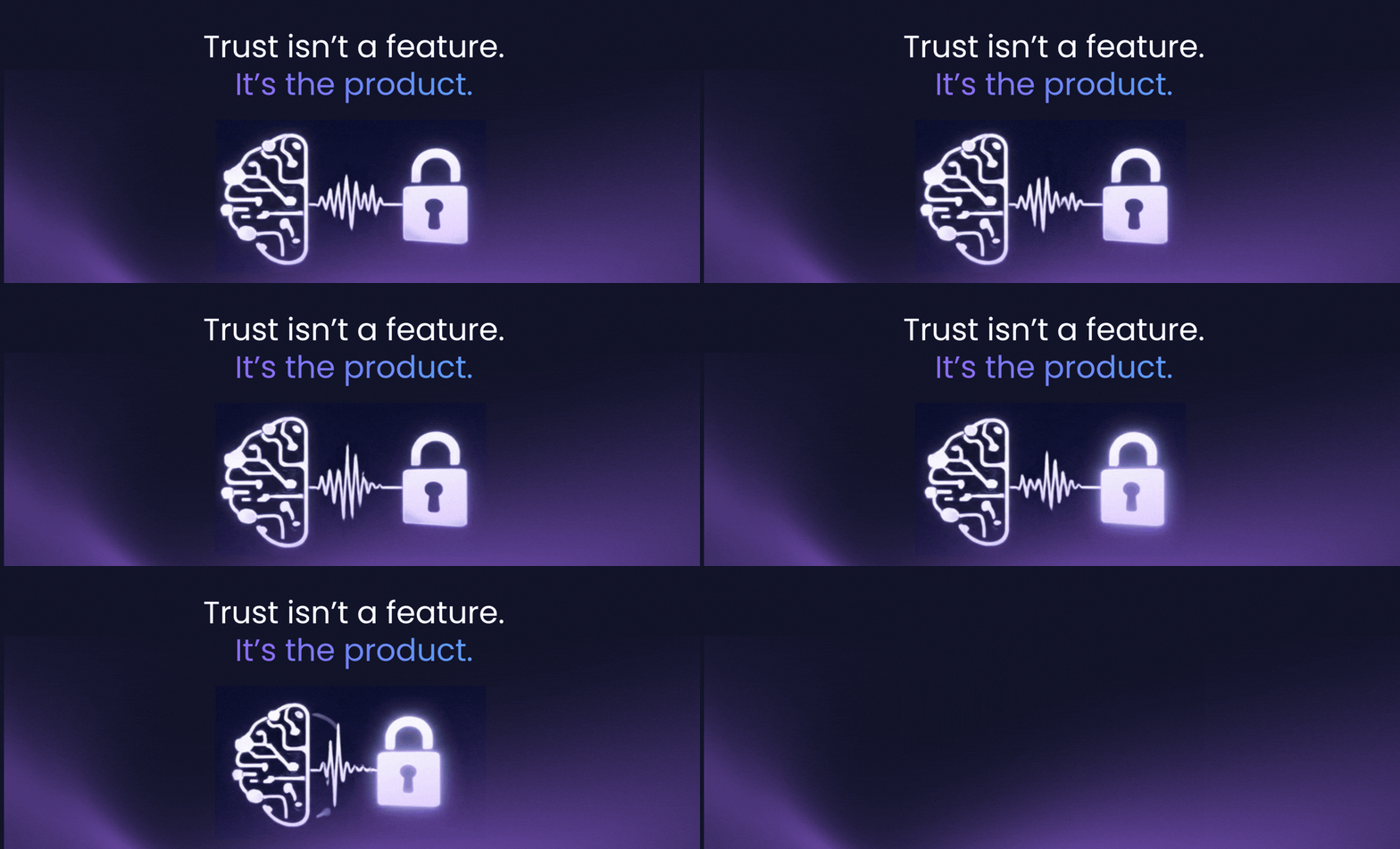
But with one critical difference: With voice AI, trust isn’t a feature. It’s the product.
Right now, many teams are impressed by how realistic Voice AI demos have become — and for good reason. The technology has advanced quickly.
But what doesn’t show up in a demo is what matters most: What happens when things go wrong.
Because most Voice AI projects don’t fail in the demo.
They fail the first time they are exposed to real-world conditions.
Voice AI Is About the System, Not Just the Model
Getting a voice agent to sound natural for a short interaction is no longer the challenge.
Making it reliable, secure, and consistent across thousands of real conversations is.
Enterprise Voice AI is not just a combination of:
- speech-to-text
- a language model
- text-to-speech
It is a real-time system that connects:
- telephony infrastructure
- business logic and workflows
- customer data
- backend systems
- human agents
All operating together, in milliseconds. A successful demo proves the model works. It does not prove the system will work in production.
Three Pillars of Production-Ready Voice AI
1. Security & Trust: Voice Is a Production Entry Point
Voice is not just another channel. It is a direct entry point into your business.
It touches identity, payments, personal data, and real-time decisions — often within a single interaction.
Enterprise Voice AI security goes far beyond basic safeguards. It requires:
- Telephony security by design: SIP infrastructure, routing controls, anti-spoofing measures
- Deterministic AI guardrails: enforcing policy during interruptions, ambiguity, and edge cases
- Data governance: clear rules on logging, storage, replay, and model training usage
- Fraud and abuse detection: protecting against adversarial behavior in a high-risk channel
The margin for error is small.
If a voice agent fails once in a high-stakes interaction, trust is lost — regardless of overall accuracy.
2. Experience & Reliability: Latency Is the New UX
In text-based interactions, a delay of a few seconds may be acceptable.
In voice, it breaks the experience.
Enterprise Voice AI must feel:
- Fast — true end-to-end responsiveness
- Natural — support for interruptions, turn-taking, and recovery mid-conversation
- Consistent — stable performance under load and across environments
Latency is not just model performance. It is the entire pipeline:
Speech recognition → reasoning → tool execution → backend systems → response generation → speech synthesis → telephony delivery
Every step matters.
In addition, real-world variability introduces complexity:
- accents and speech patterns
- background noise
- domain-specific language, names, and identifiers
Reliability also depends on resilience:
- fallback strategies when providers degrade
- timeout handling when systems slow down
- graceful failure paths that avoid dead ends
In voice, silence is not neutral.It is perceived as failure.
3. Capability: Enterprise Voice AI Must Execute, Not Just Respond
A voice agent that answers questions can demonstrate capability.
A voice agent that completes actions delivers value.
Enterprise Voice AI requires:
- Clear policies and behavioral rules
- A maintained and scoped knowledge base
- Execution capabilities through tools and workflows
- Real-time access to customer context
And critically, integration into core systems:
- CRM
- ERP
- billing and payments
- logistics and fulfillment
- identity and access management
Without this, Voice AI remains an interface — not an operational system.
Why Seamless Human Handover is Critical
Human handoff is one of the most important — and often overlooked — parts of enterprise Voice AI.
Effective handover is not just transferring the call. It includes transferring:
- the customer’s intent
- actions already taken
- verified identity signals
- the recommended next step
With a clear summary the agent can immediately act on. If Voice AI increases workload for human agents instead of reducing it, it will not scale.
The Hidden Layer: Operations
The difference between a working demo and a production system is operations.
Enterprise Voice AI requires:
- SLA design: availability, redundancy, and routing strategies
- Monitoring and alerting: visibility into latency, failures, and integrations
- Controlled rollout: phased deployment, testing, and risk mitigation
- Continuous improvement loops: tuning prompts, policies, and knowledge
- Governance: ensuring consistency, safety, and control over changes
These are not optional. They are what make Voice AI viable in production.
The Takeaway
If you are building Voice AI for the enterprise, optimize for trust at scale, not for the perfect demo.
The teams that succeed will not be those with the most impressive demos.
They will be the teams that build systems that:
- operate reliably under pressure
- handle edge cases gracefully
- integrate deeply with business systems
- maintain trust across every interaction
Because in voice, trust is not gradually earned. It is either established immediately — or lost.
The First Question
If your organization is already exploring Voice AI:
What has been the biggest challenge beyond the demo?
- Security and compliance
- Latency and reliability
- System integrations
- Human handover
Ready to move beyond Voice AI demos and into production?
See how enterprise teams are deploying secure, reliable AI agents across voice and digital.