



TL;DR
Most legacy contact centers weren’t built for the AI era, and adding AI tools one at a time won’t change that: each new tool brings another integration and another silo. The answer isn’t to rip out the contact center. It’s to change the architecture around it, with one platform that brings together AI agents, human agents, channels and enterprise systems. AIG Israel took this path, extending its existing Genesys contact center environment with CommBox instead of replacing it.
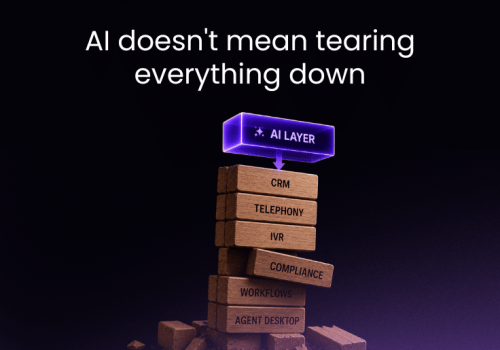
When the board asks why customer service still runs on infrastructure installed before smartphones existed, two answers usually come back. Rip it out and start over, or keep the stack and add AI tools on top: a voice agent here, a chatbot there, a copilot for agents. The first answer tends to stall once IT prices it out. The second looks faster, but it rarely scales past a few isolated use cases.
As CX Today notes, contact center modernization now carries a wider risk profile: cloud communications, AI, routing and workforce tools increasingly sit inside the same operating environment, so a weak decision in one layer creates problems across the whole operation. CommBox is an enterprise AI customer engagement platform powering 100M+ conversations annually for 300+ global enterprises, and it starts from a third answer: keep what works, and change the architecture around it.
Why do full-platform replacements stall?
Full replacement promises a clean start, but many of these projects stall before go-live. One reason, highlighted in the same CX Today analysis, is that enterprises often write RFPs around how the current system works rather than the outcomes the future operation needs, so vendors respond to a brief that protects the past. Business cases also tend to miss whole categories of existing cost, from telephone lines to server room space, which makes ROI comparisons between proposals unreliable.
Then there is change management. Moving hundreds or thousands of agents onto a new desktop environment mid-cutover is a risk most operations can’t absorb without a drop in service quality
Why doesn’t adding more AI tools fix a legacy contact center?
This is where many enterprises land instead: keep the contact center, and bolt AI onto it one use case at a time. It feels pragmatic, and the first deployment often works.
The trouble starts with the second and third. Each new AI tool brings its own integration project, its own data, its own rules and often its own vendor. The voice agent doesn’t know what happened in chat. The agent copilot doesn’t see what the AI agent already promised the customer. Every new use case adds another silo, more complexity and more cost, and the organization struggles to scale beyond isolated use cases or to prove ROI across the whole operation.
The AI isn’t the problem. The architecture it is being added to was never designed for it.
What does an AI-era contact center architecture look like?
Modernizing doesn’t require ripping out the contact center. It does require a change in architecture: one platform that brings together AI agents, human agents, channels and enterprise systems, with the agility to innovate and the control to scale.
In practice, that means four things:
- Existing infrastructure stays. Your telephony, contact center environment and CRM keep running. The platform connects to them through out-of-the-box, no-code integrations instead of replacing them. See how the platform integrates with your existing systems.
- Every use case shares the same foundation. A new AI agent, whether for service, sales or HR, reuses the same integrations, customer context, handoff rules and governance as the ones before it, so each new use case can move faster than the last.
- AI agents and people work in one flow. When a conversation needs a person, it moves to a human agent with full context, in a unified workspace that works alongside existing tools. Agents don’t have to learn a new desktop mid-transition.
- Control is built in. Deterministic guardrails, pre-defined rules that set what an AI agent can and cannot do, keep behavior consistent across every channel. CommBox is built for compliance with SOC 2, ISO 27001, HIPAA and GDPR standards.
The rollout can still be incremental: one high-impact use case on one channel, proven on live traffic, then expanded. The difference is that every expansion builds on the same platform instead of adding a new silo.
What does this look like in practice?
Take AIG Israel. Its contact center needed to become more efficient and to reduce customer churn. Rather than replacing its existing Genesys contact center environment, AIG Israel extended it with CommBox’s agile AI platform, connected to both Genesys and Salesforce.
Service and sales interactions now run on that one platform across WhatsApp, SMS, Facebook Messenger, email and the web. AIG Israel’s B2B center, B2C center and field agents all work on it, for use cases that range from claims and policy changes to renewals and payments.
That is the architecture in practice: the existing contact center environment stays, one platform connects it to every team and channel, and each new use case builds on the ones before it instead of adding another silo.
What should enterprises do next?
Before approving a replacement budget, or another standalone AI tool, ask one question: will the next use case build on the last one, or start from zero?
If your contact center runs on legacy telephony or a contact center environment you want to keep, and you’re mapping a path to AI at scale, we’d like to show you what that architecture looks like for your stack. We work with enterprise teams to identify the highest-impact starting point and build from there, one use case at a time. Schedule a conversation with our team.
Frequently Asked Questions
Can I add AI to my existing contact center without replacing my current telephony system?
Yes. An AI platform can connect to existing telephony and contact center environments, whether Avaya, Cisco, Genesys or another system, via API. AIG Israel, for example, extended its existing Genesys environment with CommBox rather than replacing it. What matters is whether AI arrives as separate tools or as one platform that every use case shares.
What’s the difference between adding AI tools and changing the architecture?
Adding AI tools gives each use case its own integration, data and rules, so complexity grows with every deployment. Changing the architecture means AI agents, human agents, channels and enterprise systems share one platform, so new use cases reuse what is already in place. Neither requires replacing the contact center.
How long does it take to see results from contact center modernization?
With an incremental rollout, results can be measured from the first use case on live traffic, and each new use case builds on the integrations, data and rules already in place.
What compliance standards should an enterprise AI contact center platform meet?
For regulated industries, look for compliance with SOC 2, ISO 27001, HIPAA and GDPR at minimum. These cover data handling, security controls and audit requirements across regions and industries.
Will agents need to learn a completely new system during the transition?
No. A unified agent workspace brings customer context and AI-recommended responses into one place alongside existing tools, so agents keep working within familiar workflows.
References
- CX Today, “Contact Center Modernization Has a New Risk Profile,” Rob Wilkinson: https://www.cxtoday.com/contact-center/contact-center-modernization-has-a-new-risk-profile/
- CommBox AI Customer Engagement Platform: https://www.commbox.io/ai-customer-service-communication-platform/
- CommBox Trust Center: https://www.commbox.io/trust-center/