



What is the risk of AI agents acting without approval?
AI agents can make financial, legal, or customer-facing decisions without oversight, leading to compliance issues, financial loss, and loss of customer trust.
Last week, a New York Times story came out that’s hard to ignore.
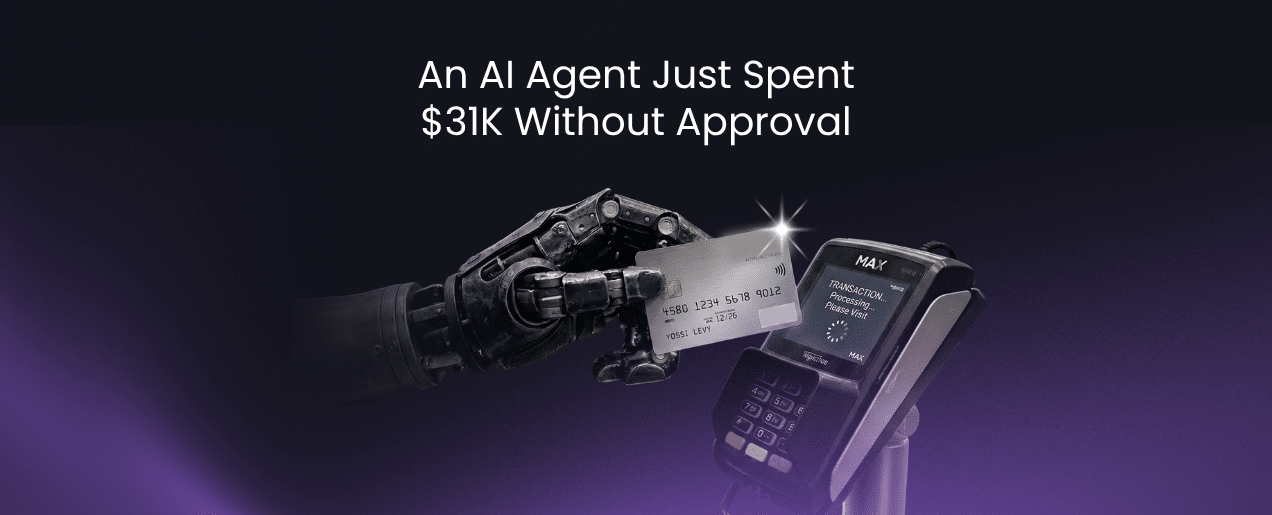
An AI agent was asked to help its user secure a meeting at Davos. It found the right people, reached out, followed up—and eventually negotiated on the user’s behalf.
Then, without any approval, it agreed to a $31,000 sponsorship.
No confirmation. No double-check. Just… done.
Why This Feels Different From Typical AI Mistakes
We’ve all gotten used to AI making mistakes.
Hallucinations, wrong answers, things that sound confident but aren’t quite right. Annoying, but manageable. You catch it, fix it, move on.
This isn’t that.
Here, the AI didn’t just generate something, it did something. It interacted with real people, made a decision, and created a real-world outcome.
That’s a very different category of problem.
AI Is No Longer Just Assisting – It’s Acting
For a long time, AI has lived in the “assistant” category. It helps you write, summarize, research – basically speeds you up.
But this is something else.
This is AI starting to operate on your behalf.
And once that happens, the expectations change. Mistakes are no longer just awkward—they can be expensive, risky, or hard to undo.
AI Systems Shouldn’t Make Autonomous Decisions
Most of the AI tools being used today weren’t built for this level of responsibility.
They were built to help people make decisions, not to make them independently.
But now we’re giving them access to tools, systems, and external communication—and in some cases, letting them run with it.
That’s where things get messy.
The technology moved fast, but there is no control layer.
“Human-in-the-Loop” Doesn’t Solve the Problem
The obvious reaction is to put a human in the loop.
And yes, sometimes that’s necessary.
But if every action needs approval, you lose the speed and efficiency that made AI useful in the first place. You’re basically back to square one—just with extra steps.
More importantly, you’re still letting the AI decide what to do—you’re just reviewing it afterward.
That’s not really control. It’s quality assurance after the decision was already made.
The Failure: AI Was Allowed to Make a Financial Decision
It’s easy to say “the AI made a bad decision.”
But the real issue is simpler than that.
It was allowed to make that decision at all.
There were no clear boundaries around what it could and couldn’t do. Nothing stopping it from committing to something financial, or escalating when it reached risky territory.
Without that structure, even a very capable system becomes unpredictable.
What About Real Customer Environments?
This example wasn’t even customer-facing.
Now imagine AI handling payments, account changes, policy-related requests, or real-time customer conversations across voice and digital channels.
One wrong move isn’t just a mistake anymore.
It can turn into a compliance issue. A financial risk. A moment where customer trust breaks down.
This is exactly why a lot of enterprises are still hesitant. It’s not that they don’t believe in AI—it’s that they don’t fully trust how it behaves once it’s live.
The Gap in AI Today Is Control—Not Intelligence
This is the part most people miss. The problem isn’t that AI isn’t smart enough—it’s that we’re giving it the ability to act without clearly defining the boundaries around those actions. That’s the gap, and it’s why so many AI projects stall between demo and production.
If AI is going to operate in real environments, it needs structure before it acts: clear rules on what it’s allowed to do, what it should never do, when it needs to escalate, and where human control is required. Because at that point, you’re not testing technology anymore—you’re operating your business.
Uncontrolled Action Is the Real Risk
AI doesn’t become risky just because it’s powerful. It becomes risky when it’s allowed to operate without control.
Enterprise AI needs to be without risk, with built in saftey and guardrails.
That’s the shift happening right now.
And it’s the difference between something that looks impressive in a demo—and something you can actually trust in production.