



In the enterprise contact center, the “North Star” hasn’t changed, but the pressure to hit it has reached a breaking point. Whether you are managing digital channels or a high-volume voice center, you are measured by two ruthless KPIs: First Contact Resolution (FCR) and Cost Per Contact.
For a decade, we were promised a “conversational revolution,” only to end up trapped in rigid If/Then decision trees that break the moment a customer goes off-script. The result? A “Fragmentation Trap” where bots talk but can’t execute, leading to frustrated customers and a “Self-Service” ceiling that never breaks.
So, is the “AI Agent” just a chatbot with a better publicist?
The short answer is no. But the difference isn’t found in the chat window – it’s found in the architecture of resolution.
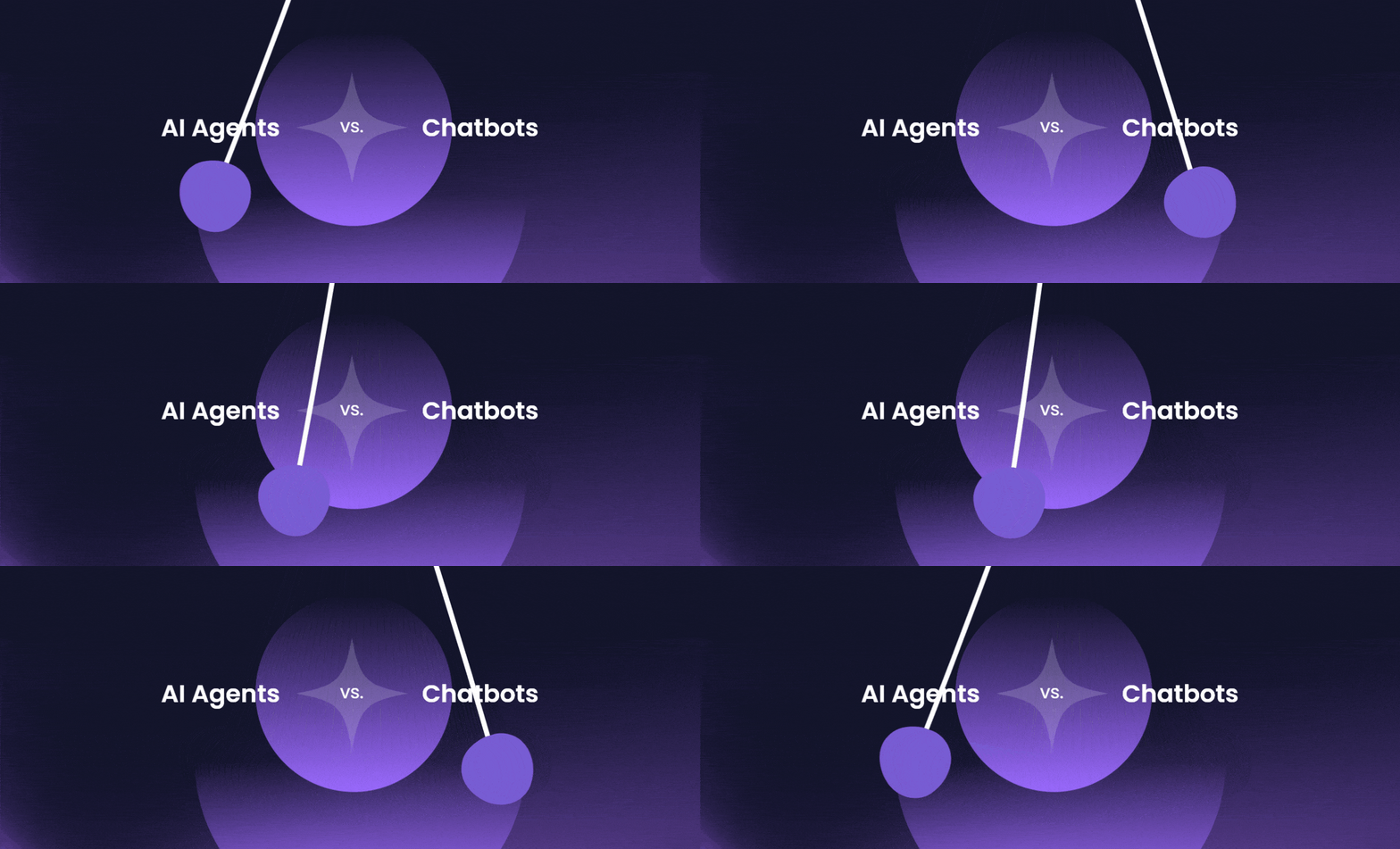
While the pendulum has spent years stuck on the side of the Legacy Chatbot (a glorified data collector), it is finally swinging toward Enterprise-Grade AI Agents, the only technology capable of actually moving your core KPIs.
The “If/Then” Dead End: Why Chat Isn’t Enough
Traditional chatbots are informational. They are digital IVRs—maps that can tell you where the water is but can’t actually bring you a glass. Because they rely on pre-defined NLP routing, they create “Integration Debt”: a mess of disconnected silos that your IT team has to manually bridge every time a business process changes.
In the enterprise, “chat” is a commodity. Execution is the currency.
The Marketing vs. Reality Check
To understand why this is a technical shift and not just a name change, we have to look at the functional DNA of these tools:
The Chatbot (Conversational UI): Its goal is to resolve a query by pointing to a resource. It lives in the front office, acts as a facade, and waits for a human to trigger a specific, narrow path. It fails the FCR test because it cannot finish the job.
The AI Agent (Autonomous Executor): Its goal is to complete a task. It doesn’t just “talk”; it uses Enterprise Memory to navigate toward an outcome. It enters your SAP or Salesforce environment, validates data, and completes the transaction autonomously.
The shift from Chatbot to Agent is the shift from “How can I help?” to “Consider it done.”
The 3 Pillars of the Technical Shift
The reason we can finally move past the hype is due to three specific technical pillars that define the “Agentic” era and directly impact your bottom line:
1. Grounded “Enterprise Memory” (RAG)
A chatbot has the memory of a goldfish. An Enterprise Agent is grounded in a 15-year data moat. By using Retrieval-Augmented Generation (RAG), the agent draws from your actual historical data and millions of daily interactions. This high-fidelity grounding is what aggressively eliminates the “hallucinations” that make most CEOs nervous.
2. Orchestration over Integration (MCP)
Old bots required custom API builds for every single task. Modern agents use the Model Context Protocol (MCP) to instantly “consume” data from core systems like SAP, Salesforce, or Microsoft Dynamics 365. They act as a vendor-agnostic orchestration layer, drastically lowering your Total Cost of Ownership (TCO).
3. Closing the 90% Back-Office Execution Gap
Chatbots are front-office window dressing. AI Agents are back-office workhorses. They coordinate multi-system workflows—matching invoices to POs, adjusting inventory in real-time, and making autonomous decisions based on your brand guardrails.
Strategic Outcomes: Moving from Chat to Cash
When you strip away the marketing, the “Agentic” shift is about moving the intelligence layer to the center of your business to hit the metrics that matter:
70% Reduction in P2P Costs: Autonomously matching invoices to POs without human intervention.
Weeks to Days: Slashed financial close (R2R) times through continuous sub-ledger reconciliation.
Absolute Governance: Full transparency and compliance with the EU AI Act, SOC-2, and GDPR.
Conclusion: Choosing the Path of Orchestration
The goal of AI in the enterprise isn’t to create more “talk.” It is to boost the business system—not blast it.
By choosing the middle path of grounded orchestration, enterprises aren’t just buying a better chatbot; they are finally building an autonomous execution layer they can actually trust to hit their KPIs. The pendulum has swung. The question is: is your architecture ready to move beyond the chat box?
Ready to move from conversation to execution? Let’s map out what a grounded AI Agent looks like for your specific business goals.