




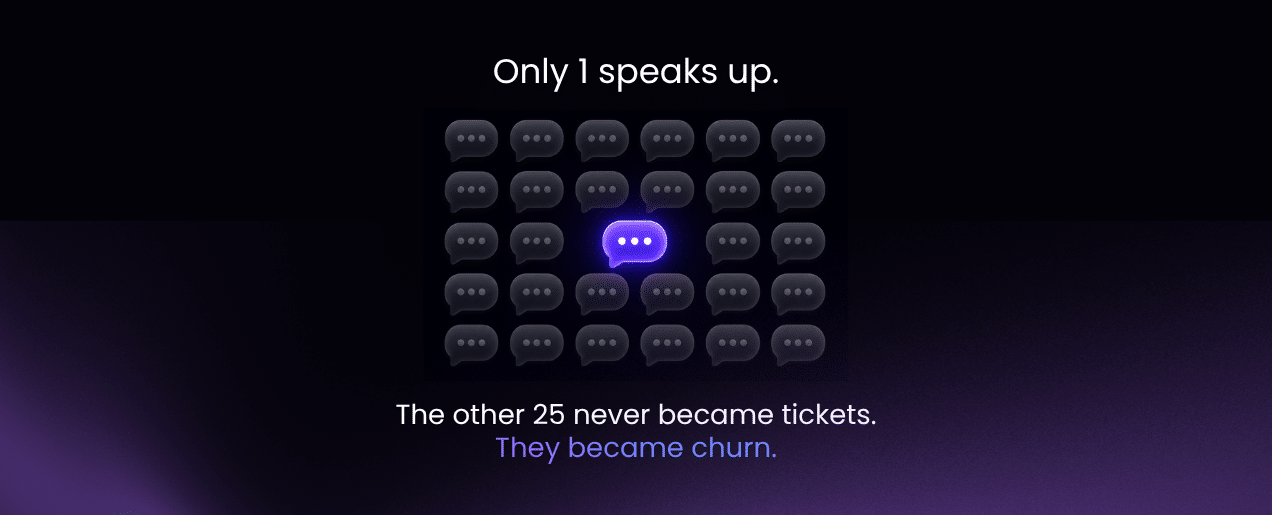
Only 1 in 26 unhappy customers actually complains. The other 25 leave silently.
That figure- attributed to customer experience researcher Esteban Kolsky (ThinkJar)- is not a quirky data point. It is a structural diagnosis. For every complaint in your queue, 25 customers are quietly deciding not to return. Your dashboards never flag them. By the time churn metrics move, the damage is already done.
CommBox is an enterprise AI customer engagement platform that enables CX teams to understand and act on customer conversations across voice, messaging, AI agents, and digital channels. Era Insights- CommBox’s AI-native operational investigation platform- actively interrogates the content of real customer conversations to explain operational outcomes, built for CX teams managing high volumes at scale.
The Reactive Trap
Most contact center operations surface problems through complaints, escalation queues, or monthly churn reports. By the time a pattern is visible, it has already affected hundreds of customers.
This is not a training problem or a staffing problem. It is structural. Complaints are the loudest signal, so operations teams tune to complaints- and everything quieter gets filtered out before it reaches a decision-maker. The result is a team perpetually firefighting: optimizing for the problems already on fire rather than the ones about to ignite.
Why BI Tools Can’t Fix This
The instinct when faced with a visibility gap is to add more dashboards. Tools like Tableau and Power BI do exactly what they were designed to do- they show you what happened, in aggregate, after the fact. What they cannot do is explain why.
Structured metrics don’t capture the content of conversations. They can’t tell you that a specific script failure on your billing team drives a spike in repeat contacts. According to Coveo’s 2022 Relevance Report: Service, 46% of customers rarely or never complain about bad experiences- they simply switch. That majority never enters your ticketing system. It lives in transcripts, call recordings, and chat logs that no BI tool- and no ticket-centric analytics platform like Zendesk or Salesforce, which surface structured case data but offer limited conversational depth- is reading.
Era Insights: Ask Your Data Anything
Era Insights makes every customer conversation queryable- in plain language, without SQL, without waiting for an analyst.
Operations leaders can ask: Why did contacts spike on Thursday? Or: What are customers saying after their first interaction with the AI agent? Era Insights searches across voice, messaging, AI agent interactions, and digital channels simultaneously, returning answers grounded in the actual content of customer conversations.
The core distinction is deliberate: dashboards show what happened. Era Insights tells you why. It is not a visualization layer, not a BI replacement, and not a generic AI summarizer- it is an AI-native operational investigation tool built to answer the questions CX leaders need answered, with full visibility into the evidence behind each answer.
The Outcome: From Firefighting to Strategy
When CX leaders have consistent, on-demand access to the why behind their data, the operating posture changes. Friction points get caught at the conversation level before they hit CSAT. Coaching opportunities surface from patterns across thousands of interactions rather than a supervisor’s sample of five calls.
Gartner predicts that by 2029, agentic AI will autonomously resolve 80% of common customer service issues without human intervention- a 30% reduction in operational costs. But that level of AI-driven operation only delivers results when the human layer above it can read what the AI is doing and where the gaps are. AI operational intelligence is the connective tissue between AI-powered execution and human-led strategy.
The shift to proactive doesn’t have to stop at the edge of the contact center. When Era Insights surfaces a pattern- an early churn signal in a customer segment, a spike in complaints tied to a specific product change- that insight can move directly into action. CommBox’s integration with marketing automation platforms like SAP Emarsys lets operations teams turn a detected signal into a retention campaign or personalized outreach without manually handing data from one team to another. What starts as an operational answer becomes a marketing action.
CX leaders who move from dashboards to operational investigation aren’t just getting better data. They’re reclaiming the capacity to lead.
Frequently Asked Questions
Can we trust AI insights from a tool like this?
Every answer in Era Insights is traceable to the underlying conversations- operations leaders can inspect the source data behind any finding. That drill-down transparency eliminates the “black box” problem and ensures findings can be acted on with confidence.
We already have dashboards. Why do we need this?
Dashboards show what happened- volume, handle time, CSAT scores. Era Insights explains why it happened by reading the actual content of conversations. Dashboards tell you a metric moved; Era Insights tells you what drove it.
Why not just use a general-purpose AI tool like GPT with our transcripts?
General-purpose AI tools lack the operational context, governance controls, and orchestration that enterprise CX environments require. Era Insights is purpose-built for CX operations- with permissions architecture, live data integrations, and deterministic behavior that enterprise deployments demand.
Can this hallucinate or return inaccurate answers?
Era Insights surfaces answers tied to actual conversation data, with drill-through to source evidence. This grounded retrieval architecture is structurally different from generative AI without constraints- when you can see what the AI is reading, you can verify what it is telling you.
What operational risk does introducing this create?
The more relevant question is the risk of not having this visibility. When 25 out of 26 dissatisfied customers leave without signaling, the absence of complaint is routinely mistaken for satisfaction. Era Insights introduces structured governance, role-based access, and audit-ready data handling- reducing operational risk rather than adding to it.
References
- Esteban Kolsky / ThinkJar- Source for the “1 in 26 unhappy customers complain” statistic. This figure is widely attributed to Kolsky’s ThinkJar research across CX literature; however, no single publicly accessible canonical URL for the original primary source could be verified. Citation noted as: Esteban Kolsky, ThinkJar Research.
- Coveo- “Coveo Research Finds Customers Have Lost All Patience for Poor Service,” GlobeNewswire, March 10, 2022– Source for the 46% of customers who rarely or never complain about bad experiences (Coveo 2022 Relevance Report: Service).
- Gartner- “Gartner Predicts Agentic AI Will Autonomously Resolve 80% of Common Customer Service Issues Without Human Intervention by 2029”– Press release, March 5, 2025.