





What real customers reveal and what it takes to turn a promising pilot into measurable value.
Voice AI demos are stellar. Pilots are promising. But most of what gets published about this technology never gets tested against the thing that actually matters: real customers, on real calls, on their worst days. They interrupt, change direction, and say things no one scripted for. In other words, they behave like real people.
Most Voice AI content right now is hype echoing hype, with vendors quoting analysts who are quoting vendors. Very little of it reflects what happens after launch, when real customers expose the neat assumptions a pilot was built on.
The gap between a successful demo and a successful deployment is where the real lessons live. It is also where many projects hit a wall.
We have spent the last stretch running Voice AI in live production environments, not lab conditions. This is what that taught us: where it works, where it breaks, what it takes to achieve measurable outcomes, and a couple of things we got wrong along the way.
The biggest lesson is simple: Voice AI succeeds not when it can hold a conversation, but when it can reliably complete the right customer journey.
You are not trying to build ChatGPT for your customers. That might feel innovative. It will not deliver ROI. The goal is a defined, measurable business outcome. Starting there shapes everything else, including which use cases you choose, how you design escalation, and how you measure success.
Start With the Outcome, Not the Conversation
The Voice AI promise is simple to state: handle high call volumes with the responsiveness of a human and the consistency of software.
That promise holds up when the journey has a clear destination, such as scheduling an appointment, reporting a claim, checking an order status, making a payment, or verifying an identity. The details vary from customer to customer, but the structure is predictable. The agent knows what information it needs, which rules apply, and what done looks like.
The mistake we see most often is assuming that because an agent can hold an open conversation, every conversation should be automated. Exploratory or emotionally charged calls introduce ambiguity that is much harder to manage reliably than a defined process.
So the right starting question is not, “Which calls can AI answer?” It is:
Which repetitive customer journeys have a defined outcome that AI can reliably complete?
What Real Customers Expose
Production traffic behaves nothing like a test set.
Customers interrupt. They answer a different question from the one asked. They change their minds halfway through a call, introduce a second issue before the first is resolved, speak from a noisy car, and bring emotion into a process designed as a clean sequence of steps. No amount of testing before launch captures the full range of this. The gap between tested well and works with real customers is not a marginal edge case. It is often the whole deployment.
There is also an adjustment curve that most teams underestimate. Voice AI is an unfamiliar presence inside a deeply familiar experience: a phone call. Some customers will hang up or ask for a human in the first few seconds, not because the agent failed, but because they were not expecting it and do not yet know what it can do.
Transparency is not optional. Tell customers upfront that they are speaking with AI. But in the same breath, give them a reason to stay: “I am an AI agent, and I can help you get this done right now.”
Here is where one of our early assumptions fell short: we underestimated just how much regional accents and speech patterns could affect performance. In linguistically diverse markets such as Israel and the UAE, overall recognition rates could look strong while specific accents or customer groups experienced more repeated clarifications.
Traditional dashboards could show us what happened, but not always why or which customer groups were affected. That level of insight came from examining the conversations themselves. It is why we built Era Insights, which enables teams to query AI and human conversations directly in natural language and quickly identify patterns hidden beneath the averages. We now track signals such as early sentiment shifts and repeated clarification requests, not only outright hang ups, so teams can refine performance continuously.
The real test of Voice AI is not whether every conversation follows the expected path. It is whether the experience can recognize when it is moving beyond the agent’s defined guardrails and recover gracefully.
Customers Don’t Care About Channels
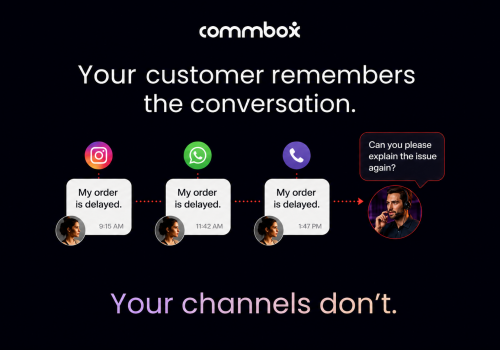
Customers care about resolving their intent, not which channel handles each step. The right channel depends on the customer, the situation, and the task. Voice may be easier for people who are less comfortable with written interactions, including some elderly customers or people communicating in a second language. Written channels may work better when an accent affects speech recognition, when the customer is in a noisy public place, or when information needs to be saved and revisited. Someone driving, however, will naturally prefer voice.
Context matters more than channel loyalty.
The goal is not to keep the customer on one channel and proudly call it resolution. It is to choose the best channel for each moment. A conversation might begin on voice, move to WhatsApp for identification, documents, confirmations, or detailed instructions, and return to voice when a discussion is easier.
Making that transition seamless is not trivial. The agent must carry everything already learned into the new channel, including the customer’s identity, intent, conversation history, and progress toward resolution. The interaction should continue exactly where it left off. Customers should not have to retell their life story simply because the medium changed.
Escalation Is a Feature, Not a Failure
Voice AI success should not be measured only by how many calls avoid a human. An interaction handled entirely by AI that fails to resolve the customer’s need is not a success. A timely handoff or a move to WhatsApp may create far more value than forced containment.
Escalation rules should be defined before launch based on topic, sentiment, and confidence. When a handoff occurs, the human agent should receive the customer’s identity, intent, collected information, and a concise summary, so the customer never has to start over.
In our early deployments, over 40% of interactions were completed entirely by AI. For the remaining 60%, context collected by AI reduced human handling time by roughly 70%. The value was not only in replacing calls. It was also in making escalated calls shorter, smarter, and far less repetitive.
Narrower Agents Perform Better
There is a natural pull toward making the agent capable of answering everything. In practice, a deliberately narrow scope performs better and is far more likely to deliver the ROI you are actually after.
Two real examples: one 20-minute conversation about the agent’s religion, and another about how human it really is. Technically, the agent sustained both conversations. Impressive? Perhaps. Valuable? Not remotely. Neither created a shred of value for the customer or the business. They simply burned time and, in one case, quite a few metered minutes.
A focused agent has clear guardrails: which topics it can handle, which sources it can trust, and when it should stop trying and gracefully end the call or hand off. It should not improvise simply to keep talking. We all know people who do that. We do not need AI joining them.
The same logic applies to the knowledge base behind it. More content does not make a better agent. A smaller, well-governed knowledge base tends to produce more accurate and consistent answers than a sprawling one filled with overlapping or outdated material.
What This Actually Takes, Operationally
Across our deployments, the difference between a successful pilot and a strong production system comes down to a few core disciplines:
- Start with journeys that are structurally repetitive but vary in detail, such as claims intake, scheduling, identity verification, order status, and payments.
- Design journeys that can move across channels from the start. Send documents and detailed information to channels customers can revisit, while preserving context.
- Define guardrails and escalation rules before launch, including permitted topics, restricted topics, and precise handoff triggers.
- Use existing customer data and history so conversations do not start cold, and ensure that context follows the customer from AI to human.
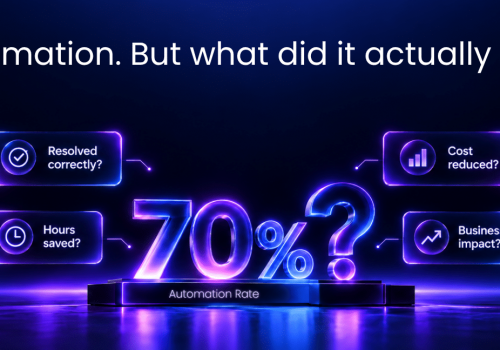
- Measure business resolution separately from containment. A conversation that never reaches a human is not necessarily resolved.
- Treat launch as the beginning. Continuously replay real conversation patterns, refine the agent, and regularly review abandonment and repeat contacts.
None of this is exotic. It is simply the discipline of treating “it worked in the pilot” as a hypothesis, not a conclusion.
The Real Opportunity
Voice AI’s value does not come from recreating a human conversation at any cost. It comes from completing the right journeys, reducing customer effort, and making the service operation genuinely more effective, including the parts still handled by people.
Technology matters. But the gap between an impressive pilot and positive ROI is mostly operational discipline. Start with a defined outcome. Expect real customers to break the happy path. Let the journey move across channels without losing context. Design escalation on purpose. Keep the agent inside its zone of competence. Measure resolution rather than only containment. Then keep learning after launch.
These are the lessons production has taught us so far, not a claim that we have every answer. Voice AI is moving too fast, and real customer behavior is too varied, for any one team to learn this alone. If you are running Voice AI in production, we would genuinely like to hear where it surprised you, where it held up, and where it did not. Comparing notes honestly is what will actually move this industry forward.