




You Don’t Need to Wait. You Need a Better Strategy.
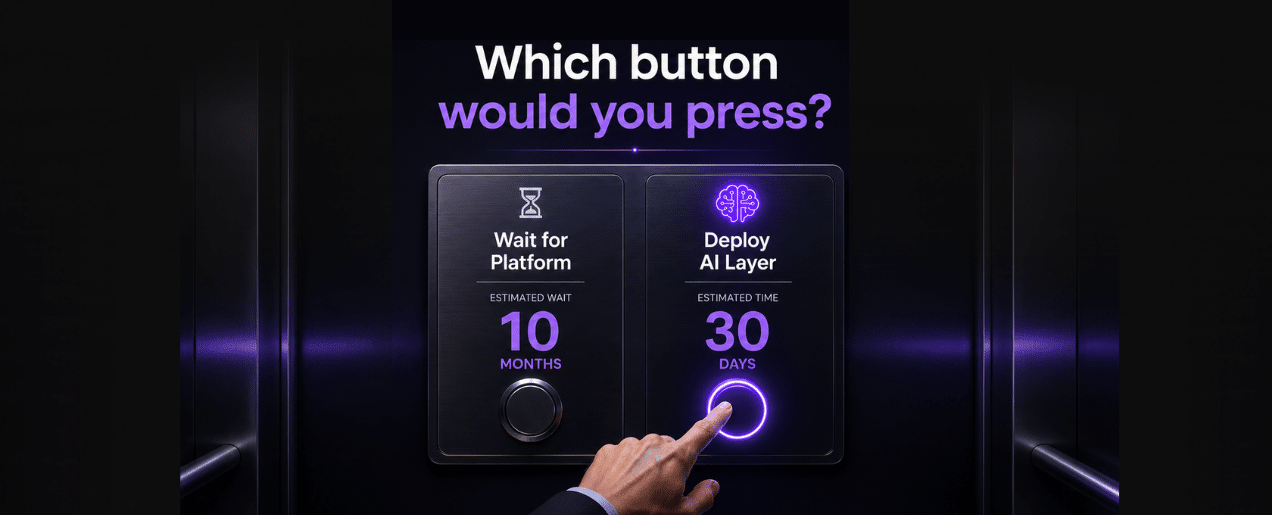
The companies seeing transformative results from contact center AI right now aren’t waiting for the perfect infrastructure moment. They aren’t holding out for a promised update to their Genesys, NICE, or Salesforce platform. They made a different strategic decision: deploy AI on top of what they already have, on their own terms and timeline, and scale at a pace that AI enables and works for their business.
What separates them isn’t budget or technology. It’s a fundamental shift in how they think about AI adoption.
Succeeding with AI in customer engagement isn’t a one-time implementation decision — it’s an ongoing, iterative discipline: build, refine, repeat. The pace of change demands a flexibility that rigid platform dependencies simply can’t support. In fact, many of our customers report that even when they finally received the awaited platform upgrade, it ended up constraining them — locking them into a narrower set of AI capabilities than they needed, missing APIs to backend systems on a roadmap they couldn’t control, at a pace that couldn’t keep up with their business.
The lesson isn’t that platforms are the wrong starting point. It’s that making AI adoption contingent on a platform decision is the wrong strategy entirely.
If you run contact center operations in a regulated industry, there’s a good chance AI is already on your roadmap — slotted somewhere after the next major contact center or CRM version upgrade, or tied to a planned platform change that keeps shifting on the timeline.
That wait is costing you more than you think.
The Hidden Cost of Waiting for “Ready”
There’s a pattern we see repeatedly: the AI business case is approved, the use cases are identified, and then everything stalls — pending a platform decision or an infrastructure upgrade with no firm date.
The data makes this pattern visible. According to Deloitte’s 2026 Global Contact Center Report, 72% of contact centers lagging competitors on automation cite systems integration as their primary obstacle — not budget, not AI readiness, not executive support. Integration.
That means the delay isn’t coming from the hard problems. It’s coming from a strategic framing that ties AI adoption to infrastructure replacement. And every month that framing holds, the cost compounds — customers frustrated by wait times and unresolved inquiries, agents burnt out on repetitive interactions they shouldn’t be handling, and revenue walking out the door to competitors who are already moving faster.
The opportunity isn’t waiting for your infrastructure to be ready. It’s recognizing that it already is.
A Different Strategy: Intelligence as a Layer, Not a Replacement
The insight that changes the equation is architectural. Your existing contact center infrastructure — telephony, CRM, routing logic — doesn’t need to be replaced to benefit from AI. It needs an intelligence layer on top of it.
An AI orchestration layer connects to your existing stack via API. It reads and writes data in real time. It handles customer interactions autonomously within defined business guardrails and policy. And it does all of this without touching your underlying infrastructure, without triggering a data migration, and without disrupting live operations.
In practice, that means:
Your telephony stays in place. Conversational voice AI overlays your existing phone infrastructure — replacing rigid IVR menus with natural, intelligent interaction — without changing a single call routing configuration. Voice AI can deflect more than 60% of your existing call volume.
Your CRM stays in place. AI agents pull customer context in real time and write interaction summaries back to existing records automatically. No parallel systems, no data reconciliation. Customers have seen as much as 85% of interactions handled autonomously by AI.
“The real value is how CommBox uses AI to connect customer intent to action at scale. That’s what allowed us to achieve over 80% resolution across channels.”
Omri Shamir, VP Digital & Innovation, UPS
Your compliance controls stay in place — and get sharper. Deterministic, rules-based guardrails define exactly what the AI handles, what it escalates, and what it declines. Every interaction is logged and fully auditable. In regulated industries, this isn’t a constraint on AI — it’s what makes AI deployable at scale.
Where the Value Shows Up — and How Fast
The financial case for this approach is concentrated in a few predictable places, and the timeline to value is measured in weeks, not years.
High-volume routine queries — policy status, claim updates, payment confirmations, account inquiries — typically consume 40–60% of agent capacity in regulated industry contact centers. These interactions don’t require human judgment. They require accurate information, delivered immediately. AI handles this autonomously, at a fraction of the cost per interaction.
IVR abandonment and repeat calls drop when customers can actually resolve their inquiry the first time. Conversational voice AI doesn’t just automate — it resolves. Fewer repeat calls means lower total volume, not just lower cost-per-contact.
After-hours coverage shifts from a staffing cost to an automation benefit. Interactions that don’t require a human get resolved immediately, around the clock. Those that do get escalated seamlessly when agents are available.
How to Capture Value Before Your Next Platform Decision
The executives moving fastest on this aren’t waiting for transformation budgets or infrastructure timelines. They’re identifying the single highest-volume, lowest-complexity interaction in their contact center today — and deploying AI to handle it autonomously, within compliance guardrails, on top of what they already have.
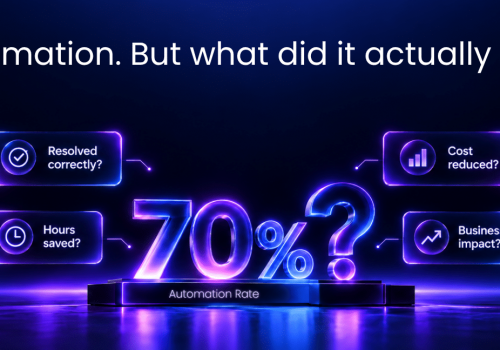
Thirty days of data from that deployment does more for an AI business case than six months of planning. It shows automation rates, cost-per-interaction delta, and customer satisfaction impact — measured, not modeled.
That’s the proof point that unlocks scale. And it’s achievable before your next quarterly planning cycle, regardless of where your platform modernization stands.
CommBox’s AI Customer Engagement Platform is built for exactly this deployment pattern — a platform-agnostic orchestration layer with pre-built connectors for NICE, Genesys, Avaya, Salesforce, and SAP, and deterministic compliance guardrails designed for regulated industries.
The infrastructure you’re waiting to replace? It’s already capable of delivering results you’re not getting from it yet.
If you want to identify the one automation opportunity in your contact center that’s achievable in the next 30 days, let’s talk. Fifteen minutes — no build required.
Frequently Asked Questions
Can we deploy AI before our platform modernization is complete?
Yes — and for most organizations in regulated industries, this is the recommended sequence. An AI orchestration layer connects to your existing infrastructure via API, delivering measurable automation results without waiting for a platform replacement or migration.
What are deterministic guardrails and why do they matter for compliance?
Deterministic guardrails are rules-based controls that define precisely what an AI agent can say, do, and escalate in any customer interaction. Unlike unconstrained generative AI, they give compliance and legal teams complete visibility and control — which is what makes AI deployable in regulated environments.
How quickly can we see results?
Targeted AI deployments on existing infrastructure typically go live within 30 to 90 days. Measurable ROI — automation rate, cost-per-interaction reduction — is generally visible within the first 30 days of operation.