



Introduction
76% of enterprise CRM data is incomplete or inaccurate. Most outbound marketing campaigns run on it anyway- while the richest, most current signal about how a customer actually feels sits one system over, inside customer service conversations, never reaching the campaign engine. This is the outbound marketing customer service data disconnect: a structural gap between what marketing knows and what service already learned. As of 2026, most enterprise stacks still treat these as two separate systems rather than one shared intelligence layer. CommBox is an enterprise AI customer engagement platform that unifies voice and digital customer interactions into a single intelligence layer- built specifically to close this gap.
Bottom Line: The outbound marketing customer service data disconnect happens when marketing campaigns run on CRM data alone while real-time service signals- sentiment, complaints, upsell intent- never reach the campaign engine. The result: wasted spend, damaged relationships, and suppressed ROI. Platforms like CommBox close this gap by connecting service interactions directly to marketing automation triggers in Salesforce and SAP, in real time.
Why Does Outbound Marketing Fail Without Service Data?
Enterprise marketing teams invest heavily in segmentation, journey mapping, and campaign automation. Yet most outbound programs are built on data that stops at the CRM- purchase history, lead scores, and pipeline stages- while the richest signals of customer intent and sentiment sit locked inside the service function.
Platforms like Zendesk house thousands of support tickets, escalations, and resolution logs. Salesforce Marketing Cloud can fire sophisticated campaign sequences. But in the typical enterprise stack, those two worlds never talk. Marketing sees a qualified contact. Service sees an account with three open escalations and a churned product line. The outbound email still goes.
This is not a technology failure- it is a structural one. Service and marketing have historically been treated as separate cost and revenue centers, with separate KPIs, separate tooling, and separate data ownership. The result is an outbound marketing program that is strategically blind: it knows who to reach, but not how that customer actually feels, what they have asked about, or what problem they are currently trying to solve.
Zendesk’s CX Trends data shows that only 31% of agents report being able to effectively see and use customer data to personalize experiences- and that is within the service function alone. Marketing teams operating downstream have even less visibility into what service has learned.
The Consequences: Reduced ROI, Damaged Relationships, Wasted Spend
When outbound marketing runs without service data, the costs are concrete.
Wasted spend on the wrong accounts. Campaigns targeting accounts that are mid-escalation, recently churned, or in active dispute are not just ineffective- they are actively harmful. Budget is consumed reaching people who will not convert, and who may share that negative experience.
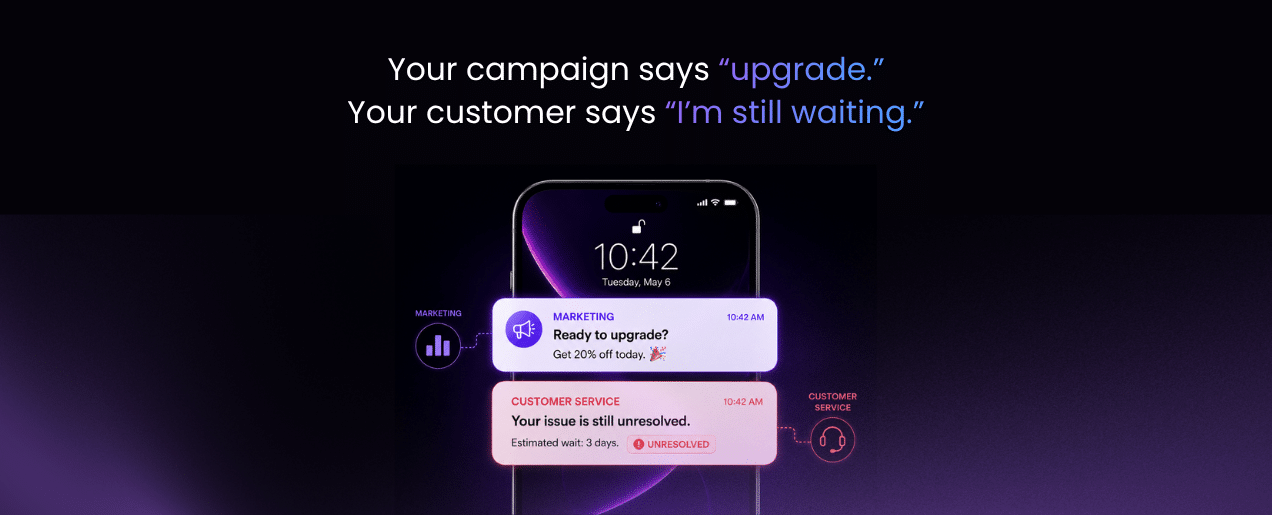
Damaged relationships at the worst possible moment. A promotional offer landing while a customer is waiting on an unresolved complaint signals that the company is not paying attention. That perception is hard to reverse, and for enterprise contracts, it accelerates churn conversations.
Suppressed ROI across every outbound channel. Validity’s State of CRM Data Management in 2025 report found that 76% of organizations say less than half of their CRM data is accurate and complete- a gap that compounds every time marketing acts on stale or incomplete records. Campaigns built on that foundation are measuring noise, not signal.
The outbound marketing customer service data disconnect does not just create awkward moments. It structurally limits the return on every campaign dollar spent.
The Goldmine of Customer Service Data for Outbound
Customer service interactions are among the most information-dense touchpoints in any customer relationship. Every conversation captures:
- Sentiment signals- whether an account is satisfied, frustrated, or actively evaluating alternatives
- Product usage gaps- which features customers are not using, struggling with, or asking about
- Upsell readiness- accounts that have successfully resolved a complex issue often represent the strongest upgrade candidates
- Proactive outreach triggers- a resolved high-priority ticket is a natural opening for a tailored follow-up from a commercial team, not a generic nurture email
When marketing teams can access this layer of intelligence, outbound shifts from mass broadcast to genuinely targeted engagement. McKinsey research shows that personalization driven by real customer data can reduce customer acquisition costs by as much as 50% and lift revenues by 5 to 15%. A customer who just resolved a technical issue with product line A and has asked three times about product line B does not need an introductory campaign- they need a direct conversation with a solutions consultant.
Service data does not just improve campaign targeting. It fundamentally changes what the “right” outbound motion is- and who should be running it.
CommBox’s Approach: One Brain, Unified Data, Real Marketing Triggers
CommBox addresses the outbound marketing customer service data disconnect at the architectural level. Rather than adding another integration layer between siloed platforms, CommBox operates as an enterprise AI customer engagement platform that treats voice and digital interactions as a single, continuous learning system.
At the center of this is what CommBox calls the Unified Brain- a shared intelligence layer where voice and digital conversations continuously inform each other, so a customer’s phone call and their WhatsApp message both update the same evolving profile rather than living in separate systems.
SAP and Salesforce as single sources of truth. CommBox integrates natively with SAP Sales Cloud, SAP Service Cloud, Salesforce Sales Cloud, and Salesforce Marketing Cloud. When service agents update a record- logging a resolved complaint, flagging a product interest, or noting an upsell opportunity- that data is immediately available to marketing automation without manual handoff, CSV exports, or overnight sync delays.
Real-time outbound triggers from service events. Rather than marketing campaigns firing on a calendar schedule against static segments, CommBox makes event-driven outbound possible: a resolved issue becomes a follow-up prompt, a product inquiry becomes a qualified lead, a proactively served notification becomes a retention touchpoint. Marketing runs on what is actually happening, not what happened last quarter.
This is not a workaround- it is a deliberate platform design decision. CommBox was built for enterprises where the gap between service and marketing is measured in revenue, not just operational friction.
Proof Point: Panasonic Connect
Panasonic Connect implemented CommBox to unify its service and commercial engagement across digital and voice channels. Within the first month of launch, the company recorded a 12% increase in lead conversion- a direct result of routing qualified service interactions into the commercial pipeline rather than letting them expire inside a support queue.
The platform’s AI resolved technical inquiries autonomously, reducing response time and agent load, while freeing human agents to focus on relationship-building conversations with measurable commercial value. The outcome demonstrated what becomes possible when service and marketing share a single operational layer: faster resolution, higher conversion, and a customer experience that feels cohesive rather than fragmented.
Source: CommBox Panasonic Connect Case Study
Frequently Asked Questions
What exactly is the outbound marketing customer service data disconnect?
It refers to the structural gap between the data marketing teams use to build and run outbound campaigns- typically limited to CRM records, lead scores, and campaign history- and the real-time intelligence that lives inside customer service interactions, including sentiment, unresolved issues, product interests, and satisfaction signals. When these two data sets do not communicate, marketing acts on an incomplete picture of the customer.
Why does this disconnect persist even in companies using Salesforce or Zendesk?
Salesforce Marketing Cloud and Zendesk are both powerful platforms within their respective domains, but they are not natively designed to share service interaction data as live outbound triggers. Integrating them typically requires custom middleware, manual data workflows, or third-party connectors- all of which introduce latency, incomplete records, and maintenance overhead. The disconnect is not about the quality of either platform; it is about the gap between them.
How does unifying service and marketing data affect outbound campaign ROI?
Directly and measurably. When outbound campaigns are built on service signals- suppressing contacts with open complaints, targeting accounts with resolved high-intent interactions, timing outreach around real customer moments- conversion rates rise, and wasted spend falls. Panasonic Connect saw a 12% lift in lead conversion within its first 30 days of CommBox deployment, a clear example of this effect at enterprise scale.
What kinds of service events should trigger outbound marketing actions?
The most high-value triggers include: a CSAT score crossing a satisfaction threshold after resolution; a service inquiry that references a product the customer does not currently own; a proactive notification that was successfully received and engaged with; and a renewal-risk flag being cleared by a service resolution. These are moments of genuine customer openness- the right time for a tailored commercial conversation, not a mass email.
Is this approach practical for large enterprises with complex existing stacks?
Yes, and it is specifically designed for them. CommBox integrates directly with SAP Sales Cloud, SAP Service Cloud, Salesforce Sales Cloud, and Salesforce Marketing Cloud, meaning enterprise teams do not need to dismantle their existing infrastructure. The platform layers on top of existing systems as a shared intelligence and engagement layer, surfacing service data where marketing automation can act on it without manual processes.
Ready to close the gap?
See how CommBox connects service and marketing data- book a demo.
References
- CommBox Panasonic Connect Case Study– 12% lead conversion lift within the first 30 days of CommBox deployment
- Zendesk- Ways Data Silos Impact Business– 31% of agents can effectively use customer data to personalize experiences
- Validity- State of CRM Data Management in 2025– 76% of organizations say less than half of their CRM data is accurate and complete
- McKinsey- What Is Personalization?– Personalization can reduce customer acquisition costs by up to 50% and lift revenues by 5-15%