



The Real Challenge of Bringing AI Into an SAP Environment
Before a single customer query gets resolved, many enterprise AI initiatives hit a fundamental challenge:
How do you introduce meaningful AI automation while staying fully synchronized with the SAP stack already running the business?
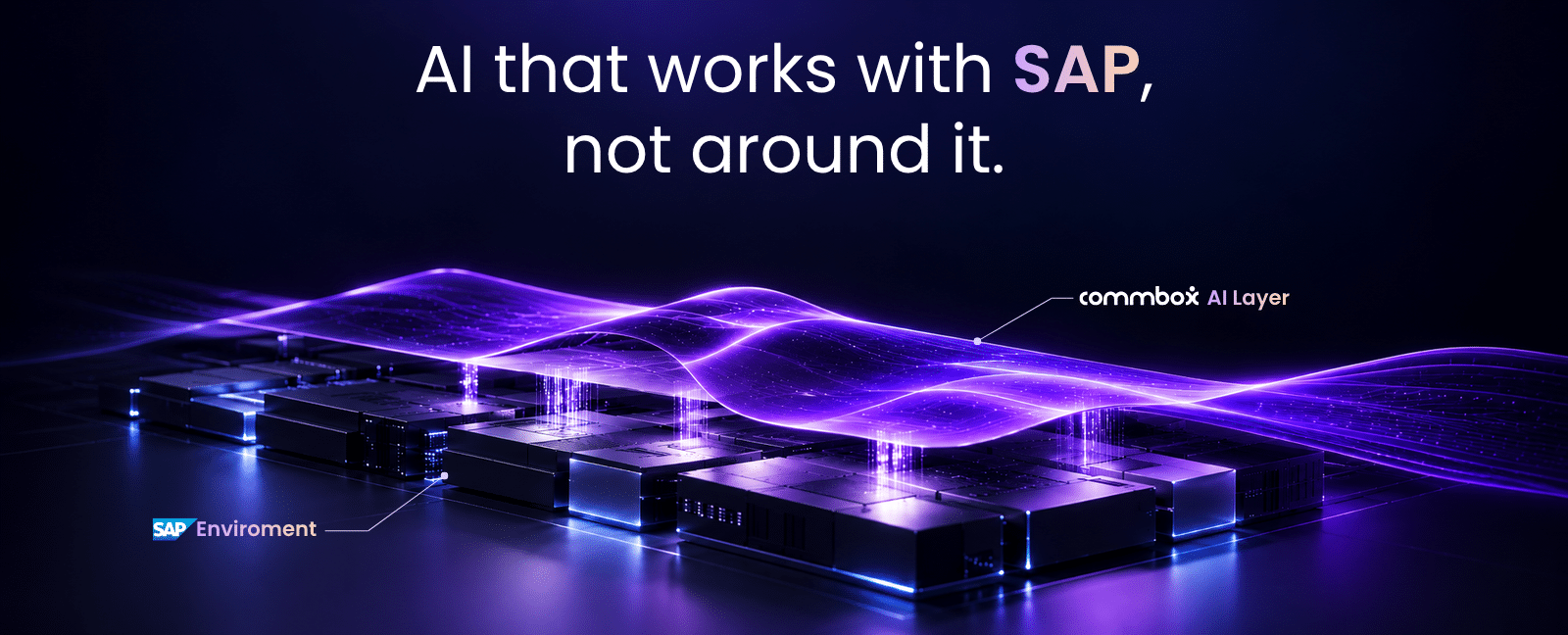
For SAP customers, AI cannot operate as a standalone layer.
An AI agent needs to understand customer and campaign context, access the right SAP data and processes, take action across existing workflows, write outcomes back into SAP, and hand over to human teams with the full conversation context intact.
The challenge isn’t simply connecting AI to SAP.
It’s making AI a natural extension of the SAP customer journey without rebuilding the CX stack around it.
After six years of partnering with SAP and supporting customers in production, CommBox has built out-of-the-box connectivity across the SAP ecosystem, including SAP Sales and Service Cloud, SAP Engagement Cloud (Emarsys), SAP CPQ, SAP SuccessFactors, and SAP ERP.
This enables enterprises to create brand-tailored AI agent journeys that stay synchronized with SAP data, processes, and customer context, from the first interaction through resolution.
The result isn’t AI bolted onto SAP.
It’s AI automation designed to work as an extension of the SAP environment, preserving the systems, processes, and data enterprises already trust while giving AI agents the context and ability to act.
And that changes what teams can spend their time on.
When an AI Project Becomes an Integration Project
Many AI platforms provide APIs, SDKs, and webhooks and leave the enterprise or its implementation partner responsible for connecting everything together.
That’s a legitimate model for organizations that want to engineer bespoke solutions from the ground up.
But for an enterprise already running SAP as a core system of record, it can quickly shift the center of gravity of the AI initiative.
Your IT and development teams become responsible for mapping SAP data objects to the AI platform, building the logic between systems, managing write-back into SAP, maintaining context across channels, handling escalation, and keeping those connections working as the underlying environment evolves.
Suddenly, the conversations are less about:
How do we increase resolution?
Why did the agent fail on this journey?
How do we improve its behavior?
Can it take the next action instead of just answering the question?
How do we increase conversion or reduce service effort?
And increasingly about:
Which API do we need?
Where does this field map?
Who owns this integration?
When can development get to it?
The focus gradually shifts from making AI work for the customer to simply making AI work with the stack.
And that’s a problem.
Because connecting an AI agent is not what delivers ROI.
What delivers ROI is continuously improving how that agent understands, acts, resolves, and ultimately achieves the intended customer outcome.
Instead of spending engineering cycles mapping data, troubleshooting connections, and maintaining custom code, enterprises should be spending their AI cycles refining agent behavior, improving journeys, testing edge cases, analyzing failed interactions, and optimizing for successful outcomes.
For enterprises running SAP, the goal should be simple: spend less time making AI connect and more time making AI perform.
What Does SAP-Connected AI Actually Look Like?
An AI orchestration layer is only as valuable as its ability to work with the systems where customer data, business processes, and actions already live.
For SAP-centric enterprises, that means the AI layer needs to work naturally across the SAP environment.
CommBox has spent six years building and refining that connectivity alongside real SAP customers in production.
Out-of-the-box connectors across SAP Sales and Service Cloud, SAP Engagement Cloud (Emarsys), SAP CPQ, SAP SuccessFactors, and SAP ERP provide the foundation for AI agents to access context, take action, and keep SAP synchronized throughout the customer journey.
In practice, that can mean:
- Customer context available to the AI agent: Customer history, account information, cases, campaign context, and other relevant SAP data can inform how the agent responds and what it does next.
- Actions connected to SAP processes: The AI agent doesn’t have to stop at answering a question. It can trigger or participate in the workflows required to move the customer toward an outcome.
- AI conversation outcomes written back into SAP: Conversation summaries, classifications, outcomes, and next actions can be synchronized with the relevant SAP record rather than living in a separate AI silo.
- Cross-channel continuity: Voice, WhatsApp, web, email, and other customer interactions can remain connected to the same customer context, allowing the journey to continue without starting over every time the channel changes.
- Human escalation with context intact: When the AI determines that a human should take over, the conversation history and relevant context can move with the customer rather than forcing them to repeat the journey.
This is what changes the deployment conversation.
Instead of asking:
“How do we build the connection?”
Teams can start asking:
“What customer journey should we automate next, and how do we make the agent better at delivering it?”
That’s a fundamentally different AI program.
From One AI Agent to Brand-Tailored AI Journeys
This becomes even more important as enterprises move beyond a single AI use case.
The future isn’t one generic bot connected to SAP.
It’s an ecosystem of AI agents tailored to specific customer journeys, business processes, campaigns, and outcomes.
A service AI agent may need to identify a customer, understand an existing case, troubleshoot an issue, trigger a service process, and determine whether the issue has actually been resolved.
A commerce or campaign AI agent may need to understand the offer a customer responded to, answer questions, access relevant product or customer information, and drive the next best action toward conversion.
An employee-facing AI agent may need to answer a question, access relevant employee information, interact with SAP SuccessFactors, initiate a process, and confirm that the employee’s request was completed.
Different journeys. Different agent behaviors. Different outcomes.
But the underlying principle is the same:
The AI shouldn’t create a new silo around the customer. It should work with the SAP data and processes already supporting that journey.
When that foundation is already available, enterprises can build, refine, and scale new AI-agent journeys without treating every use case as a new integration project.
How Does This Work for SAP Customers in Production?
Bühler Group, a global leader in industrial machinery and processing technologies, provides a good example of why this matters.
Bühler’s customer-service environment required customer communications to remain connected with SAP rather than existing across disconnected communication tools.
With CommBox, customer conversations can operate within an AI-powered environment integrated with SAP. Transcripts, recordings, and AI-generated conversation summaries can be passed into the SAP record, giving service teams a structured customer history without relying on manual documentation.
For a global manufacturer, this is about more than convenience.
When customers are contacting service because equipment needs attention, the AI experience cannot exist independently from the information and processes required to solve the problem.
The conversation is only valuable if it moves the customer toward an outcome.
And the same principle applies across industries.
A retailer doesn’t benefit because an AI agent successfully answered ten questions about a return. It benefits when the return is successfully completed with less customer and employee effort.
A manufacturer doesn’t benefit because an AI agent correctly identified a machine issue. It benefits when that understanding helps move the service process toward resolution and reduces downtime.
AI performance should ultimately be measured by the customer outcome, not simply by whether the AI successfully handled a conversation.
The Questions SAP Customers Should Be Asking AI Vendors
The integration conversation still matters. But it should establish whether the foundation exists, not become the center of the entire AI strategy.
When evaluating an AI platform for an SAP environment, ask:
- Which parts of our SAP environment can you connect to out of the box?
Don’t just ask whether a vendor “integrates with SAP.” Understand which SAP products, versions, objects, and workflows are supported and what has already been deployed in production.
- Can the AI agent access SAP context and take action, or can it only answer questions?
Retrieval alone isn’t enough. The real value comes when AI can use enterprise context and participate in the processes required to deliver an outcome.
- What gets written back into SAP?
Understand how conversations, summaries, classifications, actions, and outcomes become part of the customer record rather than remaining trapped inside the AI platform.
- What happens when the AI cannot complete the journey?
Escalation is a feature, not a failure. The important question is whether the customer reaches a human with identity, history, intent, and conversation context preserved.
- How much of our implementation will be spent on integration versus optimizing the AI agent?
This may be the most revealing question of all.
Your team should be spending its time defining journeys, improving agent behavior, testing edge cases, and measuring customer outcomes- not rebuilding connectivity that should already exist.
- How will we continuously measure and improve AI performance?
A successful launch isn’t the finish line. Enterprises need to understand where agents succeed, where journeys break, why customers escalate, and which behaviors should be refined next.
Because ultimately, the objective isn’t to deploy an AI agent. It’s to continuously improve the outcomes that AI delivers.
Conclusion: Make AI Perform, Not Just Connect
For enterprises running SAP, successful AI automation isn’t about adding another AI layer alongside the existing stack.
It’s about enabling AI agents to work across the SAP environment as naturally as the teams and processes already operating there.
And that changes where the enterprise can invest its time.
Instead of spending months figuring out how an AI agent accesses customer context, triggers the right SAP process, writes an outcome back to the record, or hands a conversation to a human, teams can focus on the questions that actually determine AI success:
- Did the agent understand what the customer needed?
- Did it take the right action?
- Did it resolve the issue or move the customer toward the intended outcome?
- And what can we learn from every interaction to make it perform better tomorrow?
That is where AI ROI is created.
After six years of working with SAP and supporting customers in production, CommBox has built the connectivity across the SAP ecosystem needed to make that possible.
But the goal isn’t simply faster integration.
It’s removing integration as the focus of the AI initiative so enterprises can focus on what matters: creating, refining, and scaling AI agents that deliver measurable customer outcomes.
Spend less time making AI connect. Spend more time making AI perform.