



Introduction
As of 2026, most enterprises manage a growing number of customer engagement channels- voice, chat, social, messaging- that were built and adopted separately, with no shared data layer connecting them. The result: every channel transfer resets the conversation. A customer who messaged the brand on WhatsApp this morning becomes a stranger when they call in this afternoon. That isn’t a training gap; it’s a structural one. CommBox is an enterprise AI customer engagement platform that unifies voice and digital customer interactions into a single intelligence layer- so that context travels with the customer, not the channel.
Bottom Line: Most enterprise customer journeys fragment because voice, chat, and social channels operate as isolated systems- each holding a different piece of the same customer story. CommBox addresses this at the data layer through its Unified AI Orchestration, a single intelligence layer that continuously connects every conversation- whether it starts on Instagram, continues on WhatsApp, or escalates to a live call- into one real-time customer record. No infrastructure replacement required.
Why does the customer journey break across channels?
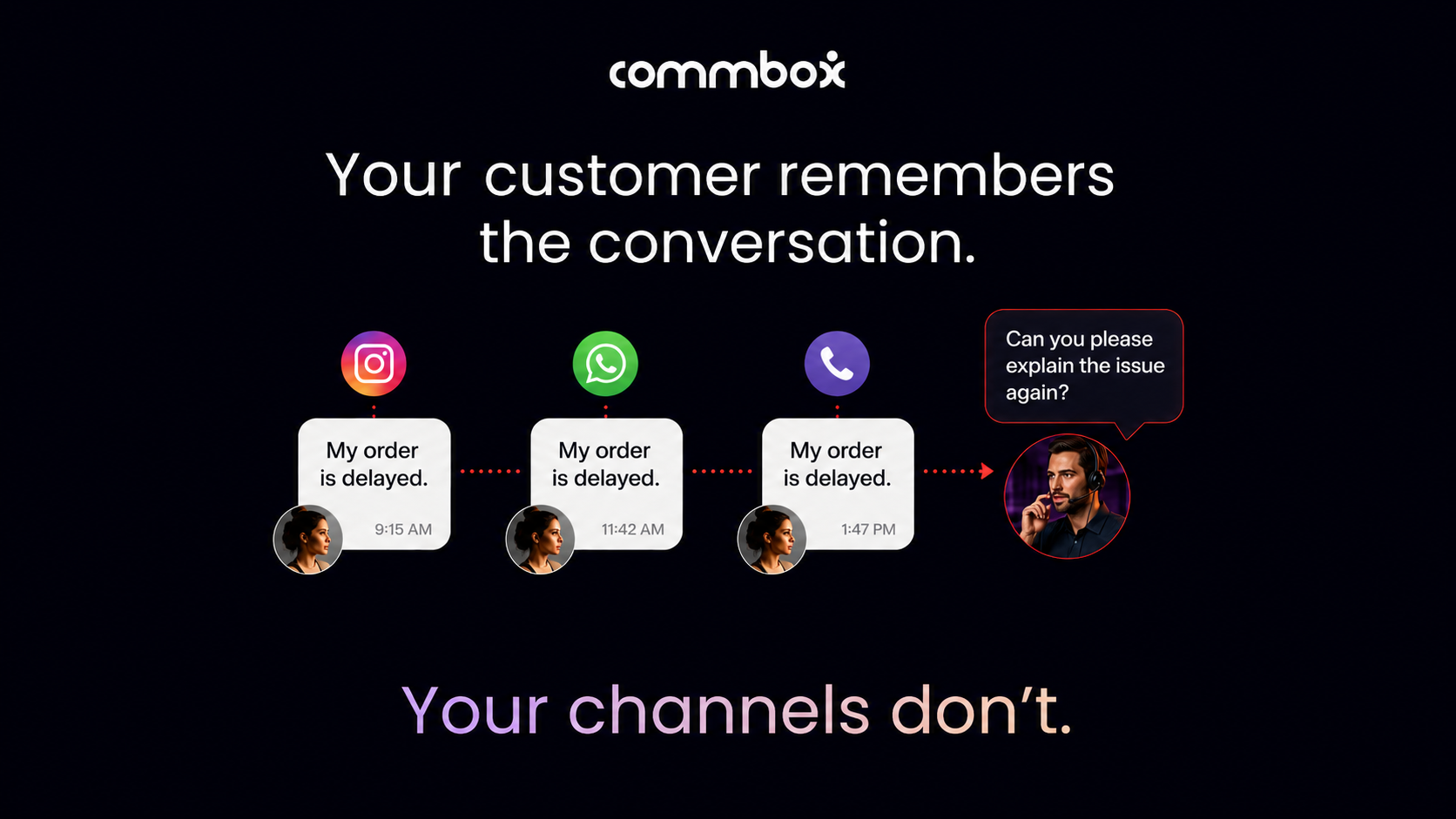
Picture a customer- call her Sara. She sees a delayed delivery notification and sends a direct message to the brand’s Instagram account. The social team logs it, promises a callback, but doesn’t resolve it. Two hours later, Sara opens WhatsApp and messages again. A different agent picks it up, asks for her order number, and starts from scratch. Frustrated, Sara calls the contact center. The phone agent has no visibility into either digital conversation. She explains her issue a third time.
Sara’s experience isn’t unusual- it’s the default. The structural reason is straightforward: most enterprises didn’t build their channel infrastructure as a unified system. Social media management tools, messaging platforms, and telephony were acquired and deployed separately, often by different teams with different KPIs. Each channel captures its own data, in its own format, stored in its own silo.
Platforms like Zendesk and Intercom have improved ticket routing across channels significantly- but both still operate from a ticket-centric model. A ticket created in Zendesk from a Twitter DM doesn’t automatically enrich the voice record when the same customer calls in. The data lives in different places, and without a layer that connects them in real time, the customer pays the price. The ticket-centric model both platforms are built on is the structural reason the gap described here persists.
According to Salesforce’s State of the Connected Customer report, 76% of customers expect consistent interactions across departments- yet 54% say it generally feels like sales, service, and marketing don’t share information. That gap is where journeys break.
What happens when context doesn’t follow the customer
When channels operate independently, agents work without the full picture. The customer repeats themselves. Different agents give different answers based on different data snapshots. Escalations stall because the receiving agent can’t see what was already tried.
The table below illustrates the difference between fragmented channels and a unified customer view:
.
Data location
What the agent sees
Customer experience
Typical Outcome
Fragmented channels
Siloed by channel (CRM, social tool, messaging platform)
Only the current channel’s history
Repeats context on every channel transfer
Higher handle time, lower CSAT, more escalations
Unified customer view
Single real-time customer record across all channels
Full cross-channel interaction history
Picks up exactly where they left off
Faster resolution, higher first-contact resolution rates
The operational cost of fragmentation is real. Agents spend a disproportionate share of every call recapturing context they shouldn’t need to ask for. Contact center managers see it in average handle time and escalation rates long before it shows up in satisfaction scores.
This same fragmentation shows up across business functions, not just channels. A customer’s service interaction rarely informs the sales or loyalty teams that talk to that same customer next- even though it’s often the most relevant context available. CommBox’s broader orchestration extends across this boundary: in one documented pattern, a customer who engages with a WhatsApp marketing message and replies with interest is automatically routed to a Sales AI agent that qualifies the lead in real time, with engagement data flowing back into the system for whatever comes next. It’s the same underlying principle as the Unified AI Orchestration- context should follow the customer, not stay locked in whichever team or tool touched them last.
What a truly unified customer view requires
Closing the fragmentation gap requires more than a shared inbox. Three things have to be true simultaneously:
A single customer record spanning all channels. Voice transcripts, WhatsApp conversations, Instagram DMs, email threads, SMS, and web chat must all write to and read from the same profile. Not a consolidated report generated at the end of the day: a live record that updates in real time.
Context that travels with the customer, not the channel. When Sara moves from Instagram to WhatsApp to a phone call, her journey follows her. The phone agent opening her profile sees the Instagram DM, the WhatsApp thread, the delivery issue, and what was already offered- before saying a word.
Real-time sync, not batch updates. Batch processing is a legacy pattern that made sense when compute was expensive. In a modern contact center, an agent who receives a customer call three hours after that customer sent a message- and still doesn’t know about the message- is operating on stale data. That’s not a technology limitation anymore; it’s an architecture choice.
This is the foundation. Without it, any AI you deploy on top- routing, suggestions, autonomous resolution- is working from an incomplete picture.
How CommBox’s Unified AI Orchestration solves this
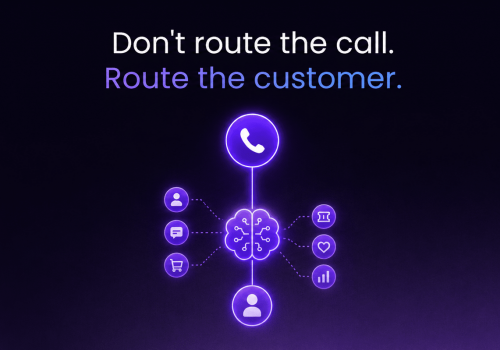
The Unified AI Orchestration is CommBox’s core intelligence layer- a single data and reasoning engine that connects every channel interaction into one continuously updated customer record. In plain terms: when a customer sends an Instagram DM, that interaction informs what the voice agent sees when the same customer calls in. When a phone call ends, the transcript, sentiment, and resolution status write back to the same record that the digital channels read from.
This matters because voice and digital channels don’t just exist side by side in CommBox- they learn from each other. A digital interaction that signals frustration updates the customer’s profile so that an AI routing engine can prioritize the next inbound call. A voice call that reveals a recurring billing complaint informs the AI agent handling the next WhatsApp query from the same customer.
CommBox layers on top of your existing telephony (Genesys, NICE, Amazon Connect) and CRM (Salesforce, SAP) without requiring you to replace them. The Unified AI Orchestration connects to your existing stack via API, reads from and writes to your current systems, and begins building unified customer intelligence from day one. Unlike platforms that require a full CRM consolidation before unification becomes possible, CommBox’s orchestration layer works with the infrastructure you already have.
The practical result: agents stop asking customers to repeat themselves. AI agents- handling WhatsApp, chat, or social- resolve queries with full context. And when a customer does reach a human, that agent has the complete cross-channel picture before the first word is spoken.
Era Voice AI, CommBox’s voice intelligence layer, sits directly on top of existing telephony to extend the Unified AI Orchestration into every phone call- replacing rigid IVR prompts with conversational AI that already knows who the customer is and what they’ve already tried.
How to start unifying your customer journey
Unification doesn’t require a ground-up rebuild- and it doesn’t require doing it alone. The highest-impact path starts narrow, and CommBox works alongside your team at every step:
- Audit your current channel data silos. Map where customer data lives for each channel- voice, WhatsApp, social, email, chat- and identify which of those records are connected today (and which aren’t). This audit typically reveals two or three channels that are completely disconnected from the others.
- Identify your highest-friction handoff point. For most enterprises, it’s the moment a customer moves from a digital channel to a phone call- or from social to any other channel. This is where context drops most reliably and where customers feel it most acutely.
- Start with your highest-friction handoff. CommBox connects the two endpoints- sharing the customer record between those two channels- so you see the impact on handle time, escalation rate, and CSAT quickly, without waiting to solve every channel at once.
- Scale from there. Once the first unified journey shows measurable results- often within weeks- expanding to additional channels becomes a straightforward next step, not a new project. Each additional channel connected to the Unified AI Orchestration adds intelligence for all the others, and the ROI compounds as you go.
Frequently Asked Questions
How is CommBox’s Unified AI Orchestration different from a shared inbox or multi-channel helpdesk?
A shared inbox aggregates messages from multiple channels into one queue- but it doesn’t unify the underlying customer data. Platforms like Zendesk route tickets across channels effectively, but a ticket created from a social DM doesn’t automatically enrich the voice record when the same customer calls in. CommBox’s Unified AI Orchestration connects the data layer- not just the queue- so that voice and digital interactions continuously update the same customer record in real time.
What is a unified customer journey across voice, chat, and social?
A unified customer journey means that every interaction a customer has- whether on WhatsApp, Instagram, a phone call, or live chat- is captured in a single real-time profile that every channel and every agent can read from. When context follows the customer rather than staying locked in a channel-specific tool, agents can pick up any conversation without asking the customer to repeat themselves.
Why do most enterprise customer journeys fragment across channels?
Because voice, messaging, and social channels were typically built and deployed by different teams, using different tools, with different data stores. Each channel operates independently and doesn’t share data with the others in real time. The result is that agents handling a phone call have no visibility into what happened on WhatsApp an hour earlier- and vice versa.
Does implementing CommBox require replacing existing telephony or CRM?
No. CommBox layers on top of your existing telephony infrastructure (Genesys, NICE, Amazon Connect) and CRM platforms (Salesforce, SAP) via API. There is no rip-and-replace of existing systems. The Unified AI Orchestration reads from and writes to your current stack, which means you begin building unified customer intelligence without infrastructure disruption.
How quickly can enterprises expect to see results from channel unification?
CommBox customers typically see measurable operational improvements within the first month of deployment. Because unification connects to existing infrastructure rather than replacing it, the highest-friction handoff point- most often the moment a customer moves from a digital channel to a phone call- can be unified first, on its own, without waiting for a broader rollout. The deployment model is designed for high-impact, fast time-to-value rather than multi-year rollouts.
Conclusion
Channel fragmentation isn’t a brand perception problem — it’s a data architecture problem. Customers who repeat themselves across channels aren’t experiencing a training failure; they’re experiencing the predictable consequence of systems that were never designed to share context. The fix isn’t faster agents or better scripting. It’s a single intelligence layer that connects every interaction, in every channel, into one continuously updated record.
CommBox’s Unified AI Orchestration does exactly that- on top of the infrastructure you already have. See how CommBox unifies your customer journey- book a demo.
References
- Salesforce- State of the Connected Customer– Source for the statistic that 76% of customers expect consistent interactions across departments, with 54% saying it generally feels like sales, service, and marketing don’t share information.
- CommBox- Enterprise AI Customer Engagement Platform– Source for platform capabilities, Unified AI Orchestration description, and deployment model.